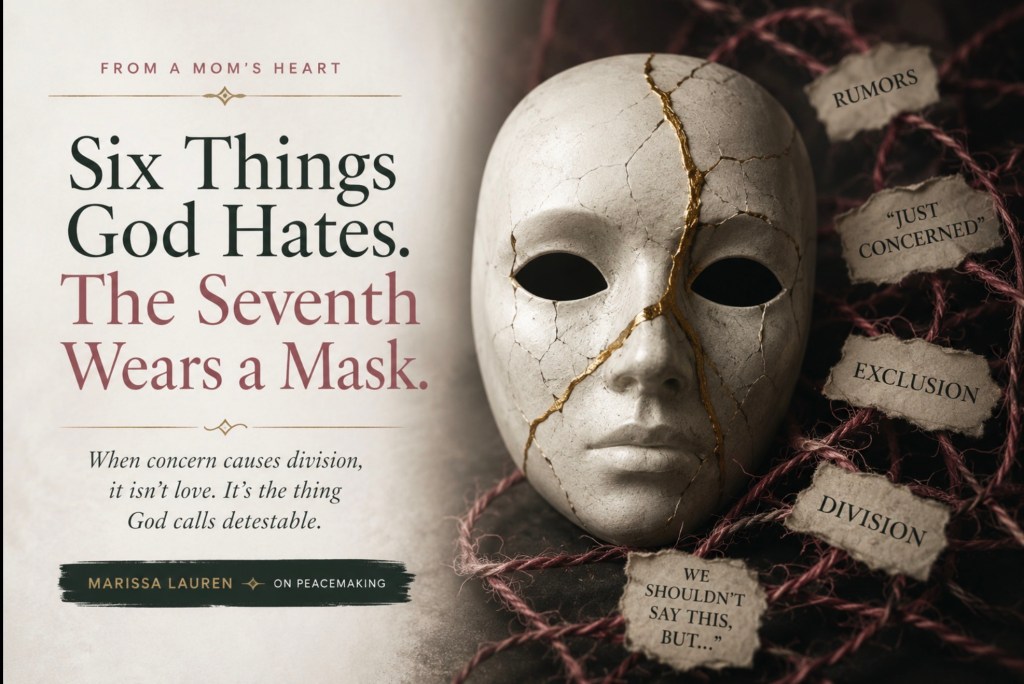
When concern causes division, it isn’t love. It’s the thing God calls detestable.
We love to blame the devil. It’s easier that way. Poor guy takes the fall for a lot of things that are actually just us, being petty, being scared, being human.
I want to talk about one of those things today. Gently, but honestly. Because I think it’s time somebody took the mask off.
Six Things, and a Seventh
There’s a well known passage that lists six things God hates, and then adds a seventh, almost like it needed its own category of detestable. That seventh one is a person who sows discord among brothers.
Not murder. Not lying, not pride, not even the other six. Sowing discord gets its own line. Its own weight. And I think that’s because it’s so sneaky. So easy to do without ever raising your voice or throwing a punch. You can sow discord with a raised eyebrow. With a “well, I probably shouldn’t say this, but…” With a group text that doesn’t include one person.
What Discord Actually Looks Like
I’m not talking about disagreement. Disagreement is healthy. I’m talking about the quiet, cumulative behaviors that pull people apart from each other, often while looking like concern, loyalty, or even love.
Things like:
- Talking about someone instead of to them
- Creating suspicion where there wasn’t any
- Backtracking or softening your words once you’re caught, instead of owning them
- Mocking someone, even “affectionately,” in front of others
- Making a person feel guilty for having a relationship with someone else
- Shaming someone privately or publicly, even inside a family or friend group
- Building alliances against a person, so it’s you and me against them
- Turning the group into a tribe, where belonging depends on picking the right side
- Outcasting someone for who they choose to associate with, or not associate with
- Jumping to conclusions before ever asking a direct question
That last pattern deserves its own moment. When we punish people for their relationships, when someone becomes suspect just because they still talk to the person we’ve decided is the problem, we’ve stopped being a family or a friend group and started being a tribe. And tribes don’t ask questions. They just ask whose side you’re on. Nobody should have to forfeit a relationship to keep their place in the circle.
Every one of these feels justified in the moment. That’s what makes it so dangerous. It rarely feels like sin while you’re doing it. It feels like protecting someone, or being real, or just venting. Sometimes it even wears spiritual clothing. We call it discernment. We call it concern. We say “I’m just worried about them.” But if the fruit of my “discernment” is that two people trust each other less, that wasn’t discernment. That was judgment in a nicer outfit.
Real discernment leads me to pray, to go directly, to seek understanding. Judgment just needs an audience.
And here’s what I’ve noticed, watching this up close more times than I’d like: it almost always starts with hurt. Somebody got wounded, and instead of taking that wound somewhere it could heal, they dressed it up as love. Suspicion in the disguise of love is still suspicion. Concern that quietly recruits people to a side isn’t concern. I say that with compassion, because hurt people rarely realize that’s what they’re doing. But naming it matters, because unhealed hurt doesn’t just stay in one heart. It travels. It divides. And the person spreading it often believes, sincerely, that they’re helping. But look at what it produces. Not clarity. Not closeness. Division.
The Better Way Is Right There
If someone has an issue with someone else, the instruction is remarkably simple: go to them directly. Not around them. Not to everyone but them. Directly. And if that doesn’t resolve it, then you bring in wise counsel, one or two others, not to build a case, but to help find reconciliation.
That is so different from how most of us actually operate. It’s so much easier to find a common enemy. There’s something about talking about the friend who isn’t in the room, about triangulating a conversation so you have an ally instead of a hard conversation, that feels good in the moment. It bonds people fast. But it’s a false bond. It’s built on someone else’s back.
The Question I Keep Asking Myself
I’m not writing this from a place of having it all figured out. I’m writing it from a mom’s heart, because I have watched families, friend groups, and teams fracture over exactly this. And I’ve had to ask myself the hard question more than once.
Here it is, and I think it’s worth sitting with:
✽ Is what I’m about to say going to bring understanding, or is it going to cause division?
✽ Does it protect this person’s autonomy and their right to choose their own relationships, or does it quietly strip that away?
✽ Is it building someone up, even in their absence, or is it tearing them down when they can’t speak for themselves?
That’s it. That’s the whole test. It doesn’t require a theology degree. It just requires honesty.
This Isn’t About Being Harsh
I don’t want to hand out condemnation here. I want to hand out a mirror, and then a hug. We all do this. I’ve done this. It sneaks in disguised as concern, as humor, as just processing out loud. There’s no shame in recognizing yourself in this. Recognizing it is actually the beginning of something beautiful.
Because here’s the good news: if we have the power to sow discord, we have just as much power to sow peace. The same mouth that can create suspicion can create safety. The same conversation that could divide two people can be the one that brings them back together. You can be the person in your family or your friend group who refuses to pass along the suspicion, who says “have you talked to them directly?”, who protects people when they’re not in the room.
That’s not a small thing. That’s holy work, and it’s available to every single one of us, starting with the very next conversation we have.
So next time you feel that pull, that little rush of bonding over someone who isn’t there, pause and ask the question. It might just save a relationship you didn’t even realize was on the line. And you might just become the peacemaker your people didn’t know they needed.
Written with love, from someone still learning too.


Leave a Reply